
HISD Alumni on How to Master a Language, Travel the Globe, Unlock New Passions During College

Sasha Cabral and Emily Tobar are college upperclassmen, political scholars, multimedia artists, global citizens, and pre-law professionals—each accomplishing they set for themselves as high schoolers in Houston ISD.
As their paths have evolved, Cabral said, the passions they follow and skills they’ve developed along the way have continued to serve them.
“It gives you peace of mind to have a plan,” Cabral said. “When you have a path set, you know what to switch around when you have to pivot.”
As both near their graduation dates, they reflect on some helpful advice for the HISD students that come after them.
Here’s what they said:
About the Alumni

Emily Tobar
Sam Houston MSTC High School ‘23
Union College ‘27
Area of Study
Spanish and Hispanic Studies, political science, and dance
Extracurriculars
Dancer for the Annual Winter Concert, Academic Opportunity Programs member
Study Abroad
Sevilla, Spain
internship
Centro de los Derechos del Migrante

Sasha Cabral
Carnegie Vanguard High School ‘24
Yale University ‘28
Area of Study
Political science and studio art
Extracurriculars
Reporter at Yale Daily News,
LSAT prep
Study Abroad
Bilbao, Spain
Internship
Emerge
Secure the Financial Aid
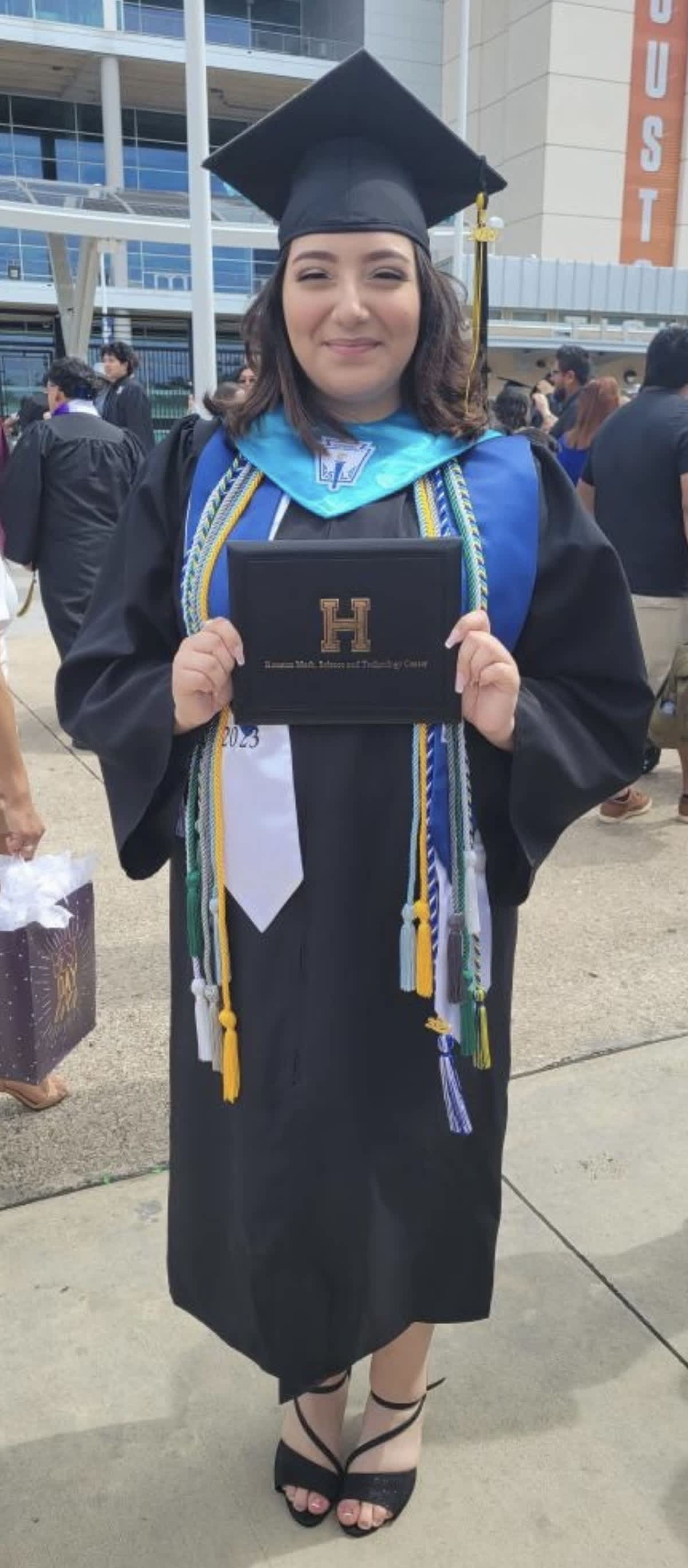
In May 2023, Tobar graduated from Sam Houston MSTC High School. (Courtesy Emily Tobar)
While attending Yale University or Union College can cost nearly $100,000 annually, they are among a number of private colleges and universities that cover the full cost of attending classes, living on campus, and study abroad programs for families that meet particular financial needs.
As high schoolers, Tobar and Cabral were enrolled in the Emerge, a Houston college counseling nonprofit that advises low-income students to apply to colleges with generous financial aid policies.
It was through her Emerge advisor that Tobar learned about Union College, which matched her preference for a smaller classrooms and liberal arts curriculum.
She has been able to study at the campus in Schenectady, New York while spending semesters in Washington, D.C. and Seville, Spain with full financial support.
“The opportunities for study abroad or studying in a different state exist in institutions that are more well-funded and have strong alumni connections,” she said.
If a school’s financial aid does not offer the full cost of attendance, applying for government aid (like the Free Application for Federal Student Aid) or scholarships from companies and nonprofits can help students to similarly take advantage of academic opportunities.
HISD administrators recommend that students consider a school’s financial aid policies and potential scholarship opportunities when deciding where to attend college, and to work with their high school counselor to find scholarship opportunities that cover what financial aid might not.
Create a Balance in High School
As rigorous coursework continues to rank among the top factors in college admissions , the balancing of Advanced Placement (AP) or honors courses with extracurriculars in high school prepared Tobar and Cabral to block out time to pursue their academic and personal goals in college.
Tobar was President of the National Honor Society and captain of the Volleyball team while at Sam Houston MSTC High school. She learned to keep open lines of communications with her teachers about deadlines and the workload as she navigated the balance, a skill she now uses in her professors’ office hours.
“When I got to Union, I was used to being in different clubs or playing sports teams and having academic work on top of that,” she said. “It was an easier transition because I exposed myself to that in high school.”
While students may be more motivated to take AP courses aligned with their intended major or for college credit, Cabral said that the practice of challenging yourself serves regardless of your college’s credit policy or your degree plan.
“Even if you doubt that they might count for credit, it's still going to benefit you,” she said.
While she didn’t submit any of her AP scores for college credit at Yale, she said she doesn’t regret taking them. As she juggles class lectures, studio hours painting, meeting deadlines at the student newspaper, and law school prep, she uses organizational skills she developed while pursuing the same goals in high school.
“College work is not as highly structured but still very great in quantity,” she said. “[AP courses] get you used to managing your time when you have more independence to decide how you're going to tackle work.”

Cabral is pictured in front of Yale’s iconic Harkness Tower during a snowy night in New Haven, Connecticut. (Courtesy Sasha Cabral)
While Cabral took AP history and government courses aligned to her current political science track, she also took science and math courses that have equipped her with the foundation to step into any college classroom, advising current high schoolers to “not shy away” from taking hard courses in all subjects.
“It’s more powerful if you can interpret things because of your past experience and background knowledge about it,” she said. “You understand the world a little bit better, and I think that’s really invaluable.”
Plan Your Courses Creatively
For Tobar, a study abroad program in Seville, Spain fit perfectly with her intended programs of study. She could immerse herself in the language and culture she studied in her Hispanic Studies classroom, while also attending flamenco dancing workshops for her dance minor. Upon her professor’s insistence she would be an ideal candidate, she pursued the opportunity.

Between Flamenco workshops and Spanish language seminars, Tobar is pictured in front of the Plaza de España in Seville, Spain. (Courtesy Emily Tobar)
However, Cabral noted that her goals of studying abroad to improve her Spanish took a little more planning under the pressures of the courses she needed to graduate. Luckily, she had a team of academic advisors to consult along the way. Together, they strategized to ensure she could meet her language requirement while studying abroad during the summer.
“[Double majoring] does not leave a lot of time in my schedule,” she said. “So I was trying to explore options over the summer that would allow me to have more space for my schedule during the school year.”
College graduation requirements can make course planning challenging, especially when scheduling conflicts or limited course availability require quick changes to stay on track. Academic advisors help by anticipating course offerings and connecting students with additional campus programs.
While Cabral had prepared a spreadsheet with every course she needed to take between 2024 and 2028 before she arrived on campus, she advises that incoming students develop relationships with advisors to make tweaks as needed.
“Flexibility comes from planning early, but use the resources that you have,” she said. “My advisors were really helpful to me by giving the feedback and guidance I needed to double major.”

Cabral explores the historic Hermitage of San Juan de Gaztelugatxe in Spain’s Basque Country, located near her host university and family. (Courtesy Sasha Cabral)
Tap Your Network for Internships
This summer, Cabral returned to Houston for an internship at Emerge, the organization that helped her apply to Yale.
At Emerge, she contributed her editorial skills to develop resources for local students who were once in her position. She said that being an alumnus of the program offered her a unique perspective on the organization's mission to use college as a stepping stone for high schoolers to accomplish their dreams.
"I felt inspired to give back to the organization that was instrumental in helping me achieve this goal. It was a full-circle moment to use my writing and communication skills to contribute to an organization that helps expand college access," she said.
In addition to Spain, Tobar had the opportunity to spend a semester studying in Washington, D.C. As part of the program, she needed to secure an internship. Unsure of where to turn, she visited a professor during office hours to express her interest in immigration law.
The professor connected her directly the to transnational nonprofit Centro de los Derechos del Migrante, where she landed a semester-long internship contributing to the legal, policy, and advocacy mission to defend migrant workers. The internship experience confirmed her desire to specialize in legal advocacy and gave her the industry experience to pursue a career as a paralegal or legal assistant before applying to law school.
“The more you make connections, the more you're going to be successful,” Tobar said. “You never know if by leaving that office hours you secure a job in the future, because that does tend to happen.”
Find Your People
During her freshman year, Cabral focused on getting acclimated academically and did not join the student paper right away. By her sophomore year, seeing several friends involved with the Yale Daily News reminded her of how much she had enjoyed reporting at CVHS’s Upstream.
Realizing she wanted to give student journalism another try, she completed the joining requirements and has since written articles spanning across subjects in university finances, campus culture, and student organizations.
Like at CVHS, she said the community she’s formed never fails to keep her interested in learning new things.
“I really feel like I found my niche [at the Yale Daily News] around people with different interests,” she said. “There's always something going on because the news never sleeps.”
While the student body at Union College looks very different from the Northside community where Tobar grew up in Houston, she has found pockets of “home” among other students of color from low-income backgrounds at the school’s Academic Opportunity Program (AOP) cohort.
Many fellow AOP members hail from Texas, or similar communities in California or the Midwest. Together, Tobar said they build network connections, share familiar cultural experiences, and maintain a sense of connection to home as they embark on their plans for the future miles away.
“It's important to have those areas, especially when you're in a predominantly white institution,” Tobar said. “I was able to expose myself to a different type of environment and still have spaces where I could connect to home.”